
How to Build a Knowledge Portfolio That Outperforms Your Competitors
The investment principle smart business owners use to gain an advantage
You wouldn’t put your entire retirement fund in a single stock. Yet most business owners stake their company’s future on a single person knowing critical processes, client relationships, and operational secrets.
Picture two similar companies facing the same challenge. Company A watches their accounting manager give notice, then seamlessly transitions operations to her backup, who already understands the systems, vendor relationships, and month-end procedures. Company B faces the identical situation but spends three months scrambling to piece together their financial processes, loses two major clients during the chaos, and still hasn’t recovered their former efficiency.
The Hidden Risk in Your Knowledge Assets
Just like a concentrated stock portfolio, concentrated knowledge creates dangerous vulnerability. When one person holds all the expertise about your CRM system, vendor negotiations, or client preferences, you’ve created what investment advisors call “concentration risk.”
Employee turnover costs include more than recruitment and training. Gallup research shows replacing managers costs around 200% of their salary, while professionals cost 80% of their salary. But these numbers don’t capture the real loss: the institutional knowledge that walks out the door.
Monthly turnover rates from the U.S. Bureau of Labor Statistics show 2.1% of employees leave voluntarily each month. That means every business faces regular knowledge departure whether they’re prepared or not.
Your Knowledge Diversification Strategy 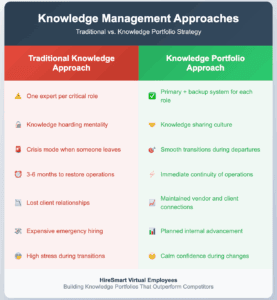
Smart investors diversify to protect against market volatility. Smart business owners diversify knowledge to protect against expertise volatility. I learned this lesson managing my own company when I realized we were dangerously dependent on key people.
My approach: I’d rather have two people doing one role: one primary, one backup. This isn’t about redundancy costs. It’s about knowledge insurance. When our VP of Operations went on maternity leave, her backup stepped into the role seamlessly because we’d been cross-training for months. No panic, no scrambling, no lost momentum.
This strategy protects against staffing disruptions while creating development opportunities for your team.
Building Your Knowledge Portfolio: A Step-by-Step Guide
Step 1: Identify Your Knowledge Concentration Risks
List employees who, if they left tomorrow, would create the biggest knowledge gaps. Focus on those handling critical processes, client relationships, or specialized systems.
Step 2: Map Critical Processes and Who Knows Them
Document every essential business function and identify the single points of failure. This includes vendor relationships, system passwords, client preferences, and operational procedures.
Step 3: Assign Backup Personnel to Shadow Experts
Choose secondary team members to learn each critical role. The backup doesn’t need to perform the full job daily, but must understand enough to step in during transitions.
Step 4: Create Knowledge Transfer Documentation
Capture the undocumented insights that live only in experts’ heads. Include vendor quirks, client communication preferences, system workarounds, and process shortcuts.
Step 5: Test Your Backup Systems Quarterly
Regularly have backups handle responsibilities to ensure knowledge transfer is effective. This prevents knowledge from becoming stagnant and identifies gaps in training.
Step 6: Rotate Responsibilities Strategically
Like rebalancing an investment portfolio, periodically rotate duties to keep knowledge fresh and distributed across your team.
When Diversification Becomes Your Competitive Edge
Companies with diversified knowledge portfolios don’t just survive employee transitions. They thrive during them. While competitors panic over departing expertise, well-prepared businesses maintain steady operations and client confidence.
This preparation also improves retention. Employees appreciate professional development opportunities and feel more secure knowing the company values knowledge sharing over knowledge hoarding.
This approach also helps prevent the dangerous dynamic where talented employees hold your business hostage because they’re the only ones who understand critical processes.
Frequently Asked Questions About Knowledge Portfolio Management
Q: What is employee cross-training and how does it work?
A: Cross-training is the practice of training employees in multiple roles to ensure business continuity. It works by assigning a backup person to shadow and learn each critical role, creating knowledge redundancy without operational redundancy.
Q: How much does knowledge loss cost when employees leave?
A: According to Gallup research, replacing managers costs around 200% of their salary, while professionals cost 80% of their salary. This doesn’t include the hidden costs of lost institutional knowledge, client relationships, and operational disruptions.
Q: What’s the difference between cross-training and hiring more staff?
A: Cross-training leverages existing employees to learn additional skills, while hiring adds headcount. Cross-training is more cost-effective and builds internal knowledge resilience without increasing fixed costs.
Q: How long does it take to implement a knowledge portfolio system?
A: Basic knowledge mapping can be completed in 2-4 weeks. Full cross-training implementation typically takes 3-6 months depending on role complexity and organizational size.
Q: What’s the primary-backup model?
A: The primary-backup model assigns two people to understand each critical role — one primary person who handles day-to-day responsibilities, and one backup who can step in during absences, transitions, or emergencies.
Q: How do you prevent knowledge concentration in growing businesses?
A: Implement systematic documentation, create knowledge-sharing protocols, avoid single points of failure in hiring, and regularly assess knowledge distribution across your team.
Protecting Your Most Valuable Investment
Your knowledge portfolio determines your company’s resilience. Like any investment strategy, diversification requires upfront effort but pays dividends when markets get volatile or when your key employees get recruited.
The companies that never panic when someone quits aren’t lucky. They’re prepared. They’ve built knowledge portfolios designed to weather any departure storm.
Smart investors don’t put all their money in one stock. Smart business owners don’t put all their knowledge in one person. Which type are you?
Click here to schedule a free consultation to discuss building your knowledge portfolio with virtual employee support.
About the Author
Anne Lackey is the Co-Founder and CEO of HireSmart Virtual Employees, where she helps businesses scale with full-time, highly trained remote staff. With decades of experience in business operations and systems, Anne is a recognized expert in virtual staffing, process efficiency, and team building.