
Your Business Has Hidden Inefficiencies: Here’s How to Find Them
The operational refresh that pays dividends all year long
Think about when you “spring clean” your house. The closet looks organized, and the garage has space again. The whole vibe of your home changes.
The organizational efforts take sweat and some aggravation, but when the “old” feels “fresh” again, you can see a real payoff to the work.
Now, think about your business. What does that “spring cleaning” look like, and have you been putting it off, the same way you may avoid the clutter in your home?
A business systems audit is a comprehensive review of your operational processes, workflows, and procedures to identify inefficiencies, eliminate redundancies, and optimize resource allocation. This operations review examines how work flows through your organization, where bottlenecks occur, and which processes no longer serve your business goals.
Of course clutter in business can be a bit more daunting, right? And honestly, a little scary. When you really brush off the dust on old systems, you might discover you’ve been doing things inefficiently for years. What if the systems you built aren’t working as well as you thought?
I’ve learned something important building HireSmart over the past decade: every single business has inefficiencies hiding in plain sight. According to 2024 research by McKinsey, two-thirds of executives see their organizations as overly complex and inefficient. This complexity manifests in duplicated work, unclear communication, and processes that made sense three years ago but don’t anymore.
The question isn’t whether you have inefficiencies. The question is whether you’ll make time to find them.
Right now, small businesses are navigating unprecedented uncertainty. Every dollar matters. Every hour counts. The irony? That’s exactly why a systems audit and a “spring cleaning” matters more than ever. You might feel like you can’t afford to pause and examine what’s not working. The truth is, you can’t afford not to.
Where Are Operational Inefficiencies Hiding in Your Business?
Most operational waste doesn’t announce itself. It’s subtle and shows up in the small things that accumulate over time, like:
- Reports that get generated but never actually inform decisions.
• Approval processes that involve three people for a $50 expense.
• Information living in multiple spreadsheets that don’t talk to each other.
• Meetings where nothing gets decided.
• Emails that create more confusion than clarity.
According to DocuSign’s 2024 Digital Maturity Report, workers spend 13 hours per week on low-value tasks. That’s not because people are lazy or careless. It’s because processes evolve organically, and nobody has time to step back and ask, “Is there a better way?”
I had a conversation with a CEO who felt pretty good about her workload. She was managing fine, working at about 60% capacity. But when we dug deeper, her two managers were drowning. They were handling work that could be done at a fraction of the cost, which meant she wasn’t investing in their leadership development. Her comfort was masking a bigger problem.
The beautiful part? When you find inefficiency, you’ve found opportunity. You’ve found time that could be redirected, money that could be reinvested, and energy that could fuel growth instead of just maintaining status quo.
 How Do You Conduct a Business Process Audit?
Let me share the approach I use at HireSmart for our operational efficiency review. We built sophisticated systems, and we still audit regularly because systems need to serve people, not the other way around. Here’s how to start.
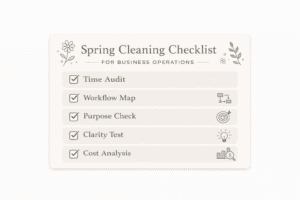
Step 1: Track Your Time
For one week, pay attention to where hours actually go. Not where your calendar says they should go, but where they really go. How much time is reactive versus proactive? I recommend this to every CEO I work with: do a time study. It’s not fun, but it’s incredibly enlightening.
When I do this exercise with clients, I share my list of 47 things CEOs should never be doing. Almost every leader I talk with is spending valuable hours on tasks that someone else could handle. Sometimes we just need permission to see it.
Step 2: Map Your Core Workflows
Pick three processes that matter most to your business. For most companies, that’s hiring, invoicing, and customer onboarding. Walk through each one step by step. Where do things consistently slow down? Where do handoffs get confusing?
Here’s the key: involve the people who actually do the work. They know exactly where the friction lives. They’ve been working around the problems for so long that they might not even mention them unless you ask.
Step 3: Ask “Why” for Every Step
For each part of your process, ask: What purpose does this serve? Sometimes you’ll find great reasons. Other times you’ll hear, “That’s just how we’ve always done it.” That’s not a business strategy. That’s a habit.
I’m not suggesting you eliminate every approval or shortcut every step. But if you can’t articulate why something happens, it’s worth questioning whether it needs to happen at all.
Step 4: Test for Clarity
Could someone new to your team understand what success looks like? Are your goals measurable, or are they vague? At HireSmart, everyone on our team knows their numbers. They know what good performance looks like. This isn’t about being controlling. It’s about being clear.
When expectations are clear, people can self-manage. They can spot their own performance issues and ask for help before small problems become big ones. Clarity is a gift you give your team.
Step 5: Run the Numbers
Calculate what your current process actually costs. Hours spent times hourly rate equals real dollars. Then compare that to what a solution might cost. The numbers often surprise my clients. What feels like “just the way things are” might be costing thousands of dollars every month in lost productivity.
What Are the First Steps in Workflow Optimization?
You don’t need to overhaul everything at once. Pick one inefficiency that’s been bothering you. That nagging thing you keep meaning to fix. Start there.
At HireSmart, I don’t personally manage our KPIs. Our team does. Each person tracks their own metrics. Department heads oversee their areas. Operations ensures everyone completes their reporting. I review the final reports. This system works because we made people responsible for their own performance tracking. They catch problems faster and solve them before issues escalate.
The point isn’t perfection, but progress. Small improvements in workplace productivity compound over time into significant operational gains.
The Payoff That Compounds Over Time
Spring cleaning your home feels satisfying for a weekend. Spring cleaning your business operations creates value all year long.
Every inefficiency you eliminate frees up capacity for something better, such as strategic thinking, team development, and innovation. You know, the things that actually grow your business instead of just keeping it running.
The most successful businesses aren’t the ones without inefficiencies. They’re the ones that make time to find them and fix them.
What could you accomplish if you reclaimed just 10 hours a week? What if your managers had more breathing room to actually lead? What if your team spent less time on busywork and more time on work that matters?
These aren’t rhetorical questions. These are real possibilities when you commit to taking an honest look at how your business operates.
You’re already working hard. Let’s make sure that hard work is pointed in the right direction.
Frequently Asked Questions About Business Systems Audits
What is a business systems audit?
A business systems audit is a systematic review of your company’s operational processes, workflows, and procedures. It identifies inefficiencies, bottlenecks, redundancies, and outdated practices that waste time and money. The goal is to streamline operations, improve productivity, and redirect resources toward strategic growth rather than maintenance.
How often should I audit my business processes?
Most businesses benefit from a comprehensive operational efficiency review at least once per year, typically during a slower business period. However, you should also conduct mini-audits quarterly to catch emerging inefficiencies before they become entrenched. Any major business change (new software, team restructuring, market shifts) should also trigger a targeted workflow analysis.
What are the signs my business needs a systems audit?
Key warning signs include: team members consistently working overtime, recurring customer complaints about the same issues, projects regularly missing deadlines, managers spending time on low-level tasks, feeling reactive rather than proactive, difficulty scaling operations, and hearing “That’s just how we’ve always done it” frequently. If you’re working harder but not seeing proportional results, it’s time for a business process optimization review.
How long does an operational efficiency review take?
A thorough systems audit typically takes 4-6 weeks for a small to mid-size business. Week one focuses on time tracking and data gathering. Weeks two and three involve process mapping and analysis. Week four addresses testing solutions. Weeks five and six implement changes and monitor results. However, you’ll see quick wins within the first two weeks as obvious inefficiencies become apparent.
Can I conduct a business systems audit myself, or do I need outside help?
You can absolutely conduct your own operational assessment, especially if you follow a structured framework. The advantage of doing it internally is your deep knowledge of your business. However, outside consultants or trained virtual employees can provide objectivity, identify blind spots you’ve normalized, and bring best practices from other industries. Many businesses use a hybrid approach: internal leadership drives the audit with external support for analysis and implementation.
Click here to schedule a free consultation and let’s talk about where your business might be losing time and money without you realizing it.
About the Author
Anne Lackey is the Co-Founder and CEO of HireSmart Virtual Employees, where she helps businesses scale with full-time, highly trained remote staff. With decades of experience in business operations and systems, Anne is a recognized expert in virtual staffing, process efficiency, and team building.