
Is Your Calendar Actually Working for You? A CEO’s Guide to Taking Back Control
Most executives are busy. Far fewer are productive. Here’s how to tell the difference.
Take an honest look at yesterday. How much of it did you actually control?
If you’re like most of the business owners I talk with, the answer is uncomfortable. Meetings appeared. Fires got put out. Someone needed five minutes that turned into forty-five. By the time the day ended, you’d been busy from morning to night and still hadn’t touched the work only you can do. That is a calendar management problem, and it has a solution.
What the Data Says About CEO Time
This isn’t just a personal productivity quirk. According to Deloitte’s 2025 Global Human Capital Trends report, leaders across organizations report that roughly 41% of their daily work time goes toward tasks that don’t actually contribute to organizational value. Nearly half your workday, gone. The culprit isn’t laziness or poor character. The culprit is the absence of a deliberate calendar management system for CEOs.
Without a system, other people’s urgencies colonize your schedule. Reactive scheduling becomes the norm. And the work that actually moves your business, the thinking, the relationships, the strategy, keeps getting deferred.
What a Real Calendar Management System Looks Like
Good executive time management starts with a time audit, not a new app. Before you restructure anything, you need to know what’s actually happening. Spend one week logging every hour. Then sort each activity into one of three categories.
The first is your zone of genius: the work where your skills, experience, and vision combine in a way no one else on your team can replicate. The second is your zone of excellence: important work you do well but that a skilled team member could handle. The third is reactive time: meetings, interruptions, and tasks that landed on your plate by default rather than by design.
Most business owners discover that their zone-of-genius work occupies a fraction of their week. Everything else is either zone-of-excellence work that should be delegated, or reactive noise that shouldn’t exist at all. A CEO productivity system built on that honest audit looks very different from a schedule built around whoever showed up in your inbox first.
The good news is that time blocking and intentional scheduling have strong evidence behind them as tools for improving both output and wellbeing, according to a 2025 peer-reviewed study in Frontiers in Education. You’re not experimenting. You’re implementing what works.
Three Practical Moves to Reclaim Your Schedule
Executive time management doesn’t require a calendar overhaul overnight. Start with these three moves.
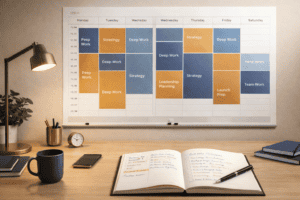
First, protect at least 90 minutes every morning for deep work before you look at email or accept a meeting. This is non-negotiable. Your best thinking happens before the day gets loud, and a strong chunky time management approach gives you the structure to guard it.
Second, run every recurring meeting through a simple filter: does this move the mission forward, or does it exist out of habit? The honest answer will free up hours each week. Many leaders discover that overloaded calendars are partly a symptom of avoiding hard decisions, including the decision to stop attending meetings that don’t need them. That kind of tunnel vision is worth confronting directly in your CEO productivity system.
Third, delegate calendar ownership. The single most impactful change many executives make is handing scheduling, correspondence triage, and meeting prep to a skilled virtual employee. When someone else is managing the flow of your day, the quality of every remaining hour improves. That’s not a luxury. That’s how productive systems actually work.
 The Delegation Connection
Calendar management for CEOs and delegation are inseparable. If you’re still personally handling every meeting request, every scheduling conflict, and every follow-up reminder, you’re using executive attention on tasks that don’t require it. And that’s a slow drain your business can’t afford.
A well-matched virtual employee, trained to understand your priorities and communication style, can own your scheduling system end-to-end. At HireSmart, the people we place go through 40 hours of certification training and are drawn from less than 1% of all applicants. They arrive ready to work. And the executives who partner with them often describe the same shift: they stopped being managed by their calendar and started managing with it.
When your team sees you protecting time for your highest-value work, it signals something important. What fills your calendar tells the people around you what you value. A reactive schedule quietly communicates that whatever is loudest wins. A deliberate one communicates leadership.
Being reactive under pressure is something most leaders struggle with at some point. The difference is whether you build systems that interrupt that pattern or just endure it.
Your Calendar Is a Leadership Statement
You started your business because you had something to build. The calendar management system you use either protects that mission or quietly undermines it, one double-booked afternoon at a time.
The leaders who make the most impact aren’t the ones who say yes to everything. They’re the ones who know exactly what deserves their attention, protect that time deliberately, and build strong enough teams to handle the rest. That’s not a productivity hack. That’s a decision about the kind of leader you want to be.
If you’re ready to build an executive time management system that actually works, and put the right support in place to sustain it, let’s talk. Click here to schedule a free consultation
Frequently Asked Questions: Calendar Management for CEOs
What is a calendar management system for CEOs? A CEO calendar management system is a deliberate framework for organizing your schedule around your highest-value work. It involves a time audit, time blocking, delegation of scheduling tasks, and a regular review process to ensure your hours align with your actual business priorities rather than other people’s demands.
How do I start improving my executive time management? Start with a one-week time audit. Log every hour and sort activities into three buckets: work only you can do, work a skilled team member could handle, and reactive noise. Most executives discover their zone-of-genius work is crowded out by the other two. From there, build blocks into your schedule specifically for that highest-value work before you accept any other commitments.
How many hours a day should a CEO spend on deep work? Research consistently supports protecting at least 90 minutes to two hours for focused, uninterrupted work each day. Many executives find morning hours are best before the day’s interruptions begin. The exact number matters less than the consistency of protecting that time as non-negotiable.
Can a virtual employee really manage a CEO’s calendar? Yes, and effectively. A skilled virtual employee can handle scheduling, meeting coordination, correspondence triage, travel arrangements, and meeting preparation. With clear systems in place and a strong working relationship, many executives find that handing off calendar ownership is one of the highest-leverage delegation decisions they make.
What’s the difference between being busy and being productive as a CEO? Busy means your calendar is full. Productive means your calendar is full of the right things. The distinction matters enormously at the executive level because your time has outsized impact on the business. A full schedule of reactive tasks still produces a reactive organization. A schedule built around your zone-of-genius work, supported by a strong team, is what produces growth.
How do I stop my calendar from filling up with low-value meetings? Three practical steps help most: First, audit your recurring meetings and eliminate or shorten the ones that don’t require your attendance. Second, set clear office hours and communication norms so your team knows when and how to reach you. Third, delegate scheduling authority to someone who can filter requests against your priorities before they ever reach you.
What role does delegation play in a CEO productivity system? Delegation is the engine of a CEO productivity system. Without it, even the best-designed schedule eventually collapses back into reactive mode because there’s no one absorbing the operational volume. The goal is to match every task to the lowest appropriate level of expertise, which frees your calendar for the strategic work your business actually needs from you.