
The Virtual Marketing Assistant Decision: Why Smart Businesses Stop Doing It Alone
When it comes to marketing, the tension you feel is real. Growth requires marketing support, yet finding the right fit feels impossible. Most business owners are caught in this cycle: they know they need help, but every traditional hiring path feels broken.
Your options feel limited. Either you hire in-house (expensive, risky, slow to productivity) or you stay understaffed (watching opportunities slip away while you are buried in social media scheduling).
The real cost of hiring in-house marketing talent goes far beyond salary. According to Gallup, the cost of replacing an employee ranges from one-half to twice their annual salary. For a $60,000 marketing hire, that is potentially $30,000 to $120,000 in replacement costs. Add training time, lost productivity during onboarding, and the stress of finding someone who actually understands your brand voice. Suddenly the math does not work.
You have tried the traditional options. They have not solved the problem.
WHY REMOTE WORK IS NO LONGER A RISK: IT IS THE NEW STANDARD
Here is what should shift your thinking. The talent expectations have fundamentally changed.
According to Pew Research Center data, 75% of employed adults with jobs that can be done from home are working remotely at least some of the time. This is not a temporary trend. It is what workers expect as standard.
Geographic boundaries no longer determine who can contribute to your team. A talented remote marketing specialist in the Philippines can execute your content calendar, manage your social media, and build your brand just as effectively as someone sitting across town. The only difference is your overhead drops dramatically.
The businesses that thrive are the ones who recognize this shift and use it to their advantage. They hire talent where it exists, not where they happen to have an office.
REFRAME: THE VIRTUAL MARKETING ASSISTANT IS NOT WHAT YOU THINK IT IS
Here is where many businesses get it wrong. They think offshore marketing support is just cheaper freelancers. That is not a virtual marketing assistant. That is outsourcing gone wrong.
A true virtual marketing assistant is different. They are full-time, dedicated, vetted, and embedded in your business culture. Understanding learn about delegation strategies is the first step to building a system that scales with your business.
This requires thinking strategically about vetting. According to the U.S. Chamber of Commerce, 90% of organizations using skills-based hiring methods report reducing their mis-hires. When you hire a marketing virtual assistant through a service that uses proper screening, DISC assessments, skills testing, and background checks, you are getting someone vetted more thoroughly than most in-house hires.
The difference is significant. You get full-time commitment without overhead. No office space. No benefits management headaches. Someone who scales with your business. They work during your business hours. Your marketing does not pause because one person took vacation.
I have discussed extensively how remote career development matters because the right support structure allows remote team members to grow, learn, and feel invested in your mission.
HOW TO ACTUALLY MAKE THIS WORK: IMPLEMENTATION 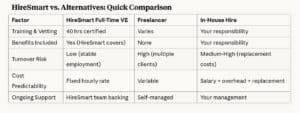
Start small. Begin with social media specialist jobs like scheduling, content calendars, and basic analytics. Low risk. Lets them learn your brand voice. This is not just practical. It is strategic.
Week-by-Week Onboarding Timeline
Your first 30 days matter. Here is how to structure them for success.
Week 1: Brand Immersion
Your virtual marketing assistant should spend their first week studying, not executing. Have them review your brand guidelines, analyze your past 50 social posts, read customer testimonials, and watch any video content you have. They should create a one-page “Brand Voice Summary” documenting tone, audience, values, and visual style. This week costs you minimal output but builds the foundation for months of consistency.
Week 2-3: Task Ownership
Now assign them 2-3 specific, low-stakes tasks. Good starter tasks include: scheduling social media posts from your pre-written calendar, organizing and tagging your content library, or responding to routine customer emails using templates you provide. Each task should have clear success criteria. Example: “Post goes live at 9 AM with correct hashtags and no spelling errors.” This builds confidence and lets you see how they handle feedback.
Week 4+: Strategic Expansion
By week four, they should be creating original content ideas, not just executing yours. They suggest social posts, identify trending topics in your industry, and propose content themes. Now they own the marketing calendar, not just the execution.
5 Critical Tasks to Delegate First (Ranked by Priority)
Not all tasks are created equal. Some build momentum fast. Others waste everyone’s time.
- Social media scheduling (15-20 hours/week) – Creates immediate, visible output. Easy to review. High confidence builder.
- Email management and templates (8-12 hours/week) – Frees your time immediately. Builds relationship with customers. Low risk if templated.
- Content calendar organization (5-8 hours/week) – Necessary busywork that feels overwhelming to you but energizes them. Shows you care about systems.
- Competitor/trend monitoring (4-6 hours/week) – Research and summaries you’d never have time for. Starts their strategic thinking.
- Customer feedback compilation (3-5 hours/week) – Surveys, comment monitoring, review management. Gives you insights you didn’t have before.
Avoid delegating highly strategic tasks (brand positioning, major campaigns) until month three. Avoid delegating client-facing sensitive calls until they’ve proven reliability for eight weeks.
Communication Tools & Check-in Rhythm
You cannot manage what you cannot see. Establish these from day one.
Regular check-ins every two hours: HireSmart recommends a structured rhythm where your assistant updates you on progress, blockers, and next steps. This creates accountability without creating micromanagement. You know what is happening without interrupting their flow.
Shared dashboard: A simple Google Sheet showing this week’s posts, customer inquiries, deadlines, and metrics. You both update it. No surprises.
Weekly sync (30 minutes): Tuesdays 10 a.m. works for most. Agenda: wins from last week, blockers, priorities for this week. Keep it tight. No tangents.
Between check-ins, they own it: During the two-hour windows between updates, they have autonomy to execute, problem-solve, and make decisions. This is key. They are not waiting for permission. They are owning the work.
Metrics That Actually Matter
Track these three things. Ignore everything else.
- Output quality: No more than 1 error per 50 pieces of content. One typo in a social post is fine. Three typos is a pattern.
- Turnaround time: They complete assigned tasks by agreed deadline 90% of the time. This shows reliability, which matters more than speed.
- Initiative: By week six, they should suggest one new idea (post topic, process improvement, content angle) per week. This signals they’re thinking, not just executing.
Once they hit these benchmarks, you’re not managing a contractor anymore. You’re leading a team member.
Once they understand your voice and your business, responsibility expands naturally. By month two, they are creating content ideas. By month three, they are thinking strategically about your social media specialist jobs and overall marketing strategy.
Weekly syncs. Shared dashboards. Transparent feedback. That is the management structure. Once systems are in place, this actually reduces your management burden compared to hiring in-house. The key is discover remote management best practices and expectations so both you and your assistant remain aligned.
According to the U.S. Bureau of Labor Statistics, telework data shows consistent productivity and engagement metrics when workers have clear expectations and regular communication. Remote workers do not need constant micromanagement. They need clarity about expectations, access to tools, and regular check-ins.
Many business owners assume remote management is harder than in-office management. It is actually easier once you have systems in place.
5 HIRING MISTAKES THAT COST YOU TIME AND MONEY
Before you hire anyone, avoid these common pitfalls. Each one costs months of lost productivity and dollars you did not expect to spend.
Mistake 1: Hiring a Freelancer and Expecting Full-Time Commitment
The trap is obvious when you think about it, but so many business owners fall in anyway. You hire someone on Upwork or Fiverr for “part-time support.” They juggle four other clients. Your urgent project gets delayed while they finish someone else’s work. By month three, they ghost you because another client offered more consistent work.
The problem: Freelancers have divided loyalty. Their primary motivation is maximizing hourly rates across multiple clients, not building your business.
The solution: Hire a full-time remote marketing specialist. One company. One focus. One mission.
Mistake 2: Skipping the Vetting Process to Save Money
You find someone who seems great. They’re available immediately. You skip the background check to save $200. Three weeks in, you discover they don’t understand your brand voice. By month two, a social media post creates a customer complaint. Now you’re managing a crisis instead of growing.
The problem: Poor vetting creates poor fit, which creates poor results, which creates turnover.
The solution: Rigorous screening matters. DISC assessments reveal personality fit. Skills testing reveals actual ability. Background checks reveal reliability. These are not luxuries. They’re insurance.
Mistake 3: Failing to Invest in Proper Onboarding
You hire someone, throw them a login and a task list, and hope for the best. Month one is chaos. They don’t understand your brand. They make mistakes. You spend more time fixing their work than if you’d done it yourself. By month two, you’re frustrated. By month three, they’re gone.
The problem: Poor onboarding creates poor performance, which creates poor morale, which creates high turnover.
The solution: Invest 40 hours in structured training. Brand immersion, task-by-task coaching, feedback loops. Front-load the work. Save yourself months of frustration.
Mistake 4: Micromanaging Remote Staff Without Clear Systems
You feel anxious about delegation. You rewrite their work before it ships. You second-guess their decisions. You create so many approval layers that nothing moves forward. They feel untrusted and disempowered. You burn them out. They leave.
The problem: Excessive control without clear frameworks creates chaos. Remote workers feel micromanaged and confused about what success looks like.
The solution: Establish a regular check-in rhythm (HireSmart recommends updates every two hours during their work shift). Use shared dashboards so you can see progress without constant interruptions. Between check-ins, they own the work. This creates accountability without creating anxiety.
Mistake 5: Treating Them Like a Freelancer, Not an Employee
You don’t invest in their growth. You don’t provide benefits. You don’t treat them like they’re part of your future. They’re just a vendor you’re renting.
The problem: No one commits to a job that doesn’t commit to them. Turnover spirals. You’re hiring every six months.
The solution: Treat them as an employee. Provide health insurance. Offer career development. Show them a future. Full-time virtual marketing staff members who feel valued stay. Freelancers always leave.
REAL NUMBERS: WHAT YOU’LL ACTUALLY SAVE
Stop guessing. Here is the actual math.
In-House Marketing Hire Scenario
Let’s say you want to hire a competent marketing professional locally. What does that cost you over year one?
Salary: $60,000
Benefits (health insurance, dental, 401k match): $18,000
Employer taxes and payroll costs: $4,590
Office space allocation (desk, chair, computer, utilities): $4,800
Initial training and onboarding: $3,000
Software and tools: $1,200
Recruiting and hiring costs: $2,500
Total if they stay: $94,090
But they probably won’t stay. According to Gallup, the cost of replacing an employee ranges from one-half to twice their annual salary. For a $60,000 hire, you’re looking at $30,000 to $120,000 in replacement costs (recruiting, retraining, lost productivity).
Total Year 1 with turnover risk: $94,090 to $214,090
HireSmart Virtual Marketing Assistant Scenario
Now let’s look at hiring a full-time offshore marketing specialist through HireSmart.
Flat hourly rate with HireSmart: When you work with HireSmart, you pay a straightforward rate for your remote marketing specialist. All benefits—health insurance, dental, ongoing support—are included in your price. No hidden costs. No office overhead. No recruiting fees. No training expenses on your end.
Compare that to an in-house hire where you’re covering salary, benefits, taxes, training, and replacement costs if they leave. Most businesses find they get better value and consistency with a full-time virtual marketing team member.
WHY HIRESMART STANDS APART
Not all virtual assistant services are equal. Many businesses hire offshore workers directly only to face communication gaps, inconsistency, and lack of accountability. HireSmart solves this differently.
Compared to Hiring Directly Overseas
You find someone on a freelance site. You save the middle man. But you inherit all the problems:
- No vetting beyond what they tell you
- No accountability if they disappear
- No replacement if they quit
- You manage the relationship solo
- You hope your timezone difference works out
When you hire directly, you get what you pay for: uncertainty.
HireSmart handles the vetting, training, accountability, and replacement. You get consistency and peace of mind.
Compared to Freelance Platforms
Freelancers on Upwork, Fiverr, and similar platforms have one job: maximize hourly rates. They juggle clients. Your project is one of five. When something better comes along, they’re gone.
Your virtual marketing assistant backed by HireSmart has one job: grow your business. They’re full-time. They’re committed. If they leave, HireSmart replaces them at no cost to you.
Compared to Other Virtual Staffing Agencies
Some agencies throw someone at you and hope it works. HireSmart invests 40 hours of hands-on training before your assistant ever touches your business. They complete DISC assessments and skills testing. They’re vetted, certified, and ready.
More importantly, HireSmart Cares provides health insurance, dental benefits, and educational scholarships for your assistant’s children. This matters. It means lower turnover, higher job satisfaction, and team members who feel genuinely valued. They’re not gig workers juggling multiple clients. They’re full-time team members committed to your growth.
CONFIDENCE BUILDERS: ADDRESSING YOUR REAL CONCERNS
“What if they do not understand my brand?”
With proper onboarding and regular feedback, remote workers often become more fluent in your brand voice than in-house hires. They have time to study it. They care about getting it right. They are not distracted by office politics or pulled in multiple directions.
One marketing agency owner shared her experience: “I scroll through our social media just to see what she posts for us next because each post is like art.” That is the level of commitment and creativity you get when you hire a full-time virtual marketing staff member who is truly invested in your success.
“What if they leave me?”
Full-time remote workers with stable employment have significantly lower turnover than traditional hires. When you hire through HireSmart, your virtual marketing assistant receives health insurance, dental benefits, and ongoing support directly from HireSmart. You pay one flat hourly rate, and HireSmart handles all the benefits and employee support. This creates a real future with your company for your assistant, and that matters.
This is the opposite of freelancers. Freelancers juggle multiple clients and disappear when something better comes along. A full-time virtual marketing assistant backed by HireSmart has invested in your success. They want to stay.
“What if I lose control of my brand?”
You do not. You have regular check-ins, shared dashboards, and approval processes. You set the strategy. They execute. It is actually more controlled than hoping a freelancer remembers what you told them last month.
“What training do virtual marketing assistants get?”
Every virtual marketing assistant placed through HireSmart undergoes 40 hours of hands-on training before ever touching your projects. They complete DISC assessments, skills testing, and background checks. This means your offshore marketing support arrives ready to contribute from day one, not weeks or months into a traditional onboarding process.
WHY HIRESMART: STABILITY AND SUPPORT YOU CAN COUNT ON
Not all virtual assistant services are equal. Many businesses hire offshore workers directly only to face communication gaps, inconsistency, and lack of accountability. HireSmart solves this differently.
Every remote marketing specialist placed through HireSmart undergoes 40 hours of hands-on training before ever touching your projects. They are vetted through DISC assessments, skills testing, and background checks. More importantly, they are backed by ongoing support from the HireSmart team.
One marketing company owner described working with HireSmart this way: “I could walk away and go on vacation, and I know our business is in great hands. It is beautiful. It is wonderful. It is perfect.” That confidence comes from knowing your assistant is not just trained, but personally supported and accountable to someone who cares about your success.
WHETHER YOU CALL IT…
…a virtual marketing assistant, offshore marketing support, remote marketing specialist, full-time marketing staff, or remote marketing team member—HireSmart delivers the same outcome: your marketing runs while you focus on growth.
THE CLOSE: BUILDING THE BUSINESS THAT DOES NOT DEPEND ON YOU
Remember that opening tension? Your options felt limited: hire expensive in-house or stay understaffed.
The real choice is different. Keep your marketing dependent on you and your stress levels, or explore scalable business systems while you focus on what actually drives revenue.
That is what a virtual marketing assistant does. It is not a shortcut. It is the path to building a real business. One that can grow, scale, and thrive without you personally managing every marketing detail.
The businesses that thrive are not the ones where founders do everything. They are the ones who strategically delegate to the right people. A virtual marketing assistant is that person for your marketing.
Your brand voice stays consistent. Your marketing keeps moving. You get your time back.
That is not outsourcing. That is scaling.
Click here to schedule a free consultation. Discover how other business owners are freeing up their time while their marketing runs like clockwork.
About the Author
Anne Lackey is the Co-Founder and CEO of HireSmart Virtual Employees, where she helps businesses scale with full-time, highly trained remote staff. With decades of experience in business operations and systems, Anne is a recognized expert in virtual staffing, process efficiency, and team building.